Last month BSI and LEIA hosted the two-day CEN TC10 Plenary meeting at the National Theatre on London’s South Bank.
CEN is the European Standards body, and TC10 is the technical committee responsible for developing standards for lifts, escalators and related equipment. TC10 includes representatives from national standards bodies, including BSI. The purpose of the plenary meeting is to plan the committee’s work for the year ahead.
Opening the meeting, Dave Searle, Chair of the BSI MHE/4 Committee for lifts, hoists and escalators, highlighted the importance of CEN’s work for new equipment. He outlined other areas of activity at BSI, including standards for testing, modernisation and improving lifts for use by firefighters and for evacuation.
Nick Mellor, LEIA Managing Director, welcomed delegates on behalf of LEIA and underlined the value of collaboration between trade associations and standardisation bodies in achieving consensus and developing high-quality standards.
Micky Grover-White, LEIA Technical Manager and member of BSI MHE/4 and several CEN working groups, emphasised the UK’s continued commitment to CEN membership, which is separate from the European Union. He explains: “Following the UK’s departure from the European Union, LEIA continues to receive queries about the status of European standards in the UK. The British Standards Institution (BSI) remains a full member of European standardisation bodies such as CEN, which is responsible for standards for lifts, escalators and moving walks. As a CEN member, BSI publishes CEN standards as BS ENs, ensuring that the UK continues to align with European standards in this sector.
CEN, CENELEC and ETSI are independent of the EU and include members from outside the EU. At the time of Brexit, BSI took steps to ensure it retained membership of these organisations. As the UK’s national standards body, BSI is committed to remaining a full member of the European Committee for Standardization (CEN), which brings together national standards bodies across Europe.”
CEN provides a framework for developing European Standards and other technical documents. Its members work together to reach a consensus on how each standard is formulated.
Because BSI remains an active member, the UK can continue to:
> contribute to European technical work
> propose new work items
> apply to hold secretariats and nominate committee chairs
> comment on developing standards
Once a standard has been developed, the UK must:
> adopt it identically (using the UK’s designated standards system)
> withdraw any conflicting national standards
BSI must also follow CEN’s rules and procedures.
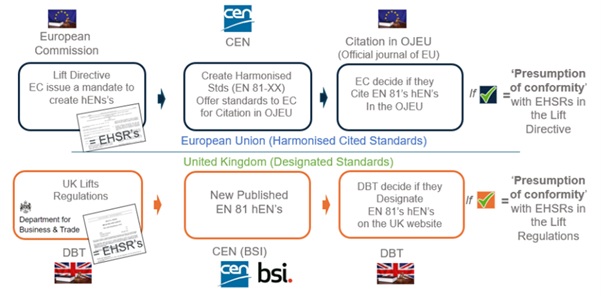
After standards are finalised in the EU, they are published and, once checked by the European Commission, listed in the Official Journal of the European Union (OJEU). At that point, they can offer a presumption of conformity and be cited on the Declaration of Conformity (DoC).
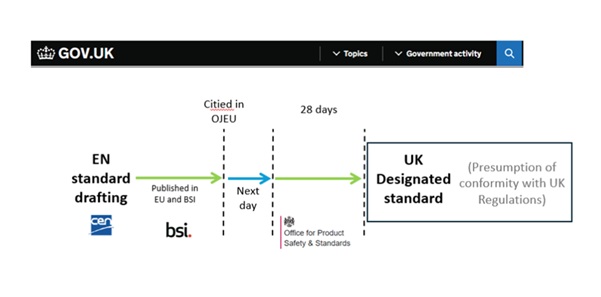
A similar approach applies in the UK. Standards are published by BSI at the same time as in the EU, but they do not automatically provide a presumption of conformity. This is only possible once the UK formally adopts the standard and it is listed on the GOV.UK website.
The process is as follows: after a standard is published in the EU and listed in the OJEU, the UK begins its designation process. On the day after the OJEU listing, the standard is opened for objection for 28 days. If there are no objections, then on day 29 the standard is listed on the GOV.UK website and lift contractors may treat it as offering a presumption of conformity and cite it on the Declaration of Conformity (DoC).